Free Resources

Licensing your art for the first time can feel a little daunting. There’s a contract sitting in front of you with words like exclusivity and royalties and a quiet worry that if you ask too many questions you’ll come across as difficult or scare the company off entirely.
I remember that feeling so well, because I’ve been there many times. So I want to reassure you - asking good questions is exactly what a professional does. It isn’t being awkward or ungrateful. It’s you looking after your work and your future income, and any company worth working with will respect you more for it, not less.
I want to walk you through one of my own licensing deals, where I agreed to license a design for diamond painting kits. Although I was excited about it, I still made sure I understood everything clearly before I signed the contract. So here’s exactly what I got clarity on:
1. Understand how you actually get paid
The company offered me €600 upfront, with royalties starting after 6,000 copies had been sold. My first question was simple: how does that actually work?
Was the €600 an advance against future royalties? Was it payment for the first print run? And what royalty percentage would I receive once royalties kicked in?
Those are very different arrangements, so I wanted to understand exactly what I was agreeing to.
Before you sign, make sure you know:
What's the royalty rate?
When do royalties begin?
Is the upfront payment on top of your royalties, or is it earned back from them first?
I never sign until I can explain the payment structure in one simple sentence.
2. Get clarity on vague language
The agreement mentioned exclusivity over "other creative activities" and "similar creative hobby products." That could mean almost anything.
So I asked them to clarify exactly what those phrases meant. This matters because "similar products" could accidentally stop you licensing your work across a whole range of products you never intended to give up. Ask for a clear list of the products and categories covered by the exclusivity.
3. Protect the income you already have
I regularly license my artwork for puzzles. So when puzzles appeared in the exclusivity list, I asked for them to be removed. Whenever you see an exclusivity clause, ask yourself:
Where does my artwork already earn money, and where might it earn money in the future?
Those are the categories worth protecting.
4. Know your territory
I also asked whether the exclusivity was worldwide or limited to certain countries. Giving someone worldwide rights isn't necessarily a bad thing, but it's a much bigger commitment than licensing your work in one or two markets. You just want to know exactly what you're agreeing to before you say yes.
5. Ask for samples and credit
I asked for four samples of the finished kit, and the company was already planning to credit the artists on the packaging and pop a little leaflet inside. None of these are cheeky asks. Holding your own work in the real world is one of the best feelings there is, and proper credit slowly builds your name. So don't be afraid to ask for a few samples and to be credited.
6. The one thing I’d add if I did it again
There's one thing I forgot to ask at the beginning:
How long does the exclusivity last?
A one-year exclusive licence is a very different agreement from a ten-year one. When I received the contract, I realised the exclusivity was for ten years, so I asked whether they'd reduce it to five instead.
And they agreed yay!
Now it's one of the first questions I ask.
And the tone, which is the part most people miss
Looking back, the thing I'm proudest of isn't negotiating better terms. It's the tone of the conversation.
Here's an example of the initial email I sent to the company:
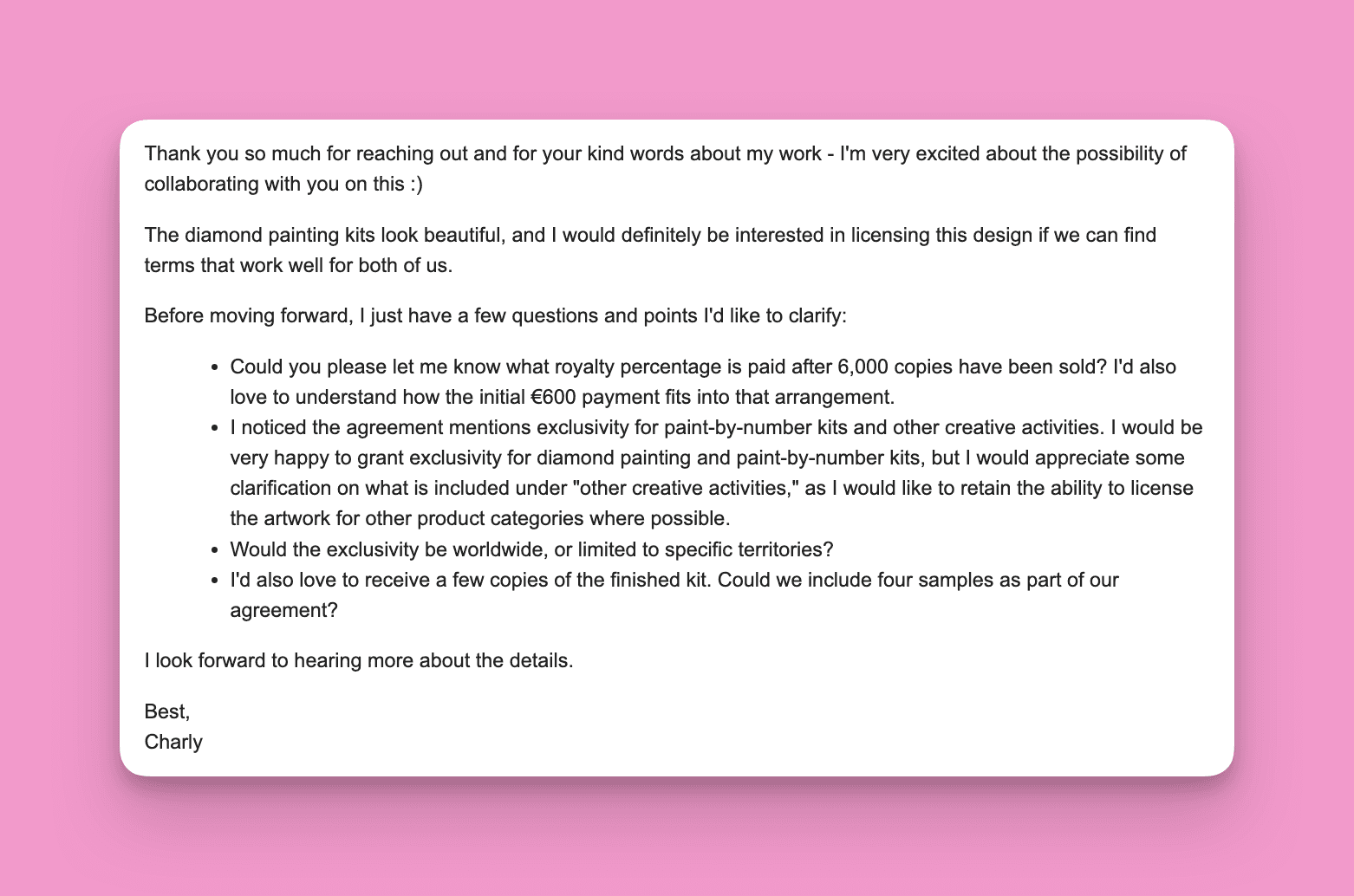
I was excited about working together and I was grateful for the opportunity. But I was also completely clear about the things I needed to understand before signing.
You don't have to choose between being kind and protecting yourself.
The best business relationships usually involve both 😊
Your quick checklist before you sign anything
What’s the royalty rate, and when does it start?
Is there an advance, and is it on top of royalties or earned back from them?
Exactly which product categories does exclusivity cover? (Get the full list in writing)
Is it worldwide, or limited to certain countries?
How long does the exclusivity last?
Can we remove a category I already license elsewhere?
Will I be credited, and can I receive a few samples?
You don’t need to be a lawyer to do this well. You just need to read slowly, ask questions out loud, and never sign something you don’t fully understand. And if it feels unclear or doesn’t sit well with you, that’s not you being difficult. It’s the agreement not being clear enough yet.
I hope this gives you a little more confidence the next time a licensing contract lands in your inbox!
You’re more ready for this than you think 💕
Love Charly x